
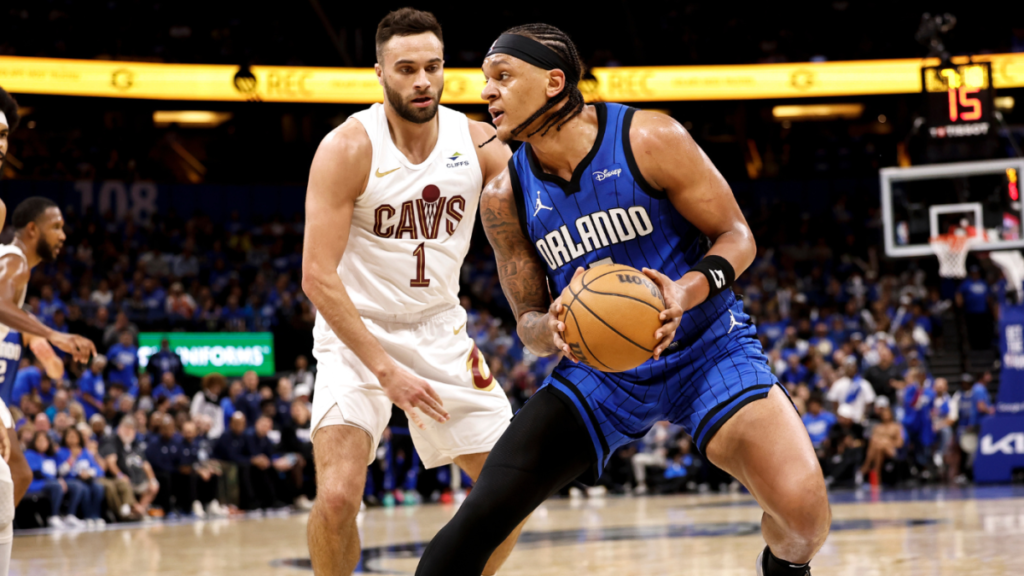

Introduction to Cleveland Cavaliers vs Orlando Magic Match Player Stats
The Cleveland Cavaliers vs Orlando Magic match player stats provide a detailed look at how individual performances shaped the result of the March 16, 2025 NBA matchup. Cleveland entered the game as one of the Eastern Conference’s strongest teams, while Orlando was looking to produce a statement win on the road. The Magic eventually secured a 108–103 victory over the Cavaliers at Rocket Arena.
The game was competitive from the opening minutes. Cleveland started strongly and built an early advantage, but Orlando gradually changed the momentum after halftime. The Magic’s improved offensive execution, balanced scoring and defensive pressure helped them overcome the Cavaliers’ early lead. The final five-point margin reflected how closely contested the game became.
Looking at individual numbers gives more context than the final score alone. Cleveland received strong contributions from Jarrett Allen, Darius Garland and Donovan Mitchell, while Orlando relied on several starters and important contributions from its bench. The box score shows how scoring, rebounding, assists, shooting efficiency and turnovers all influenced the outcome.
For readers researching Cleveland Cavaliers vs Orlando Magic match player stats, this game is especially interesting because the winning team did not simply depend on one dominant scorer. Instead, Orlando received useful production across its rotation, particularly from Franz Wagner, Paolo Banchero and Wendell Carter Jr.
This article breaks down the major player statistics, explains the key performances and examines the numbers that made the difference. It also looks at shooting efficiency, rebounding, playmaking and the overall team comparison.
Cleveland Cavaliers Player Performance
Donovan Mitchell’s Scoring Performance
Donovan Mitchell remained one of Cleveland’s primary offensive options throughout the game. He finished with 23 points, six rebounds and five assists while playing more than 34 minutes. Mitchell also recorded three made three-pointers, although his overall shooting percentage was limited by a difficult 9-for-28 night from the field.
His 23 points made him one of Cleveland’s leading scorers, but the efficiency numbers tell a more complicated story. Mitchell attempted 28 field goals and 14 three-pointers, meaning Orlando’s defense forced him into a high-volume shooting role. He made only three of his 14 attempts from beyond the arc.
Mitchell still contributed in other areas. His six rebounds and five assists demonstrated that he was not relying exclusively on scoring. He also recorded a steal and helped Cleveland create offensive opportunities even when his shot was not falling consistently.
The fourth quarter was particularly challenging for Mitchell. He scored seven points in the period but shot 3-for-12 from the field. Orlando’s defensive pressure made it difficult for Cleveland to generate efficient offense during the closing stages.
The Cleveland Cavaliers vs Orlando Magic match player stats therefore show Mitchell as a high-impact player whose overall contribution was significant, even though his shooting efficiency was below his usual standard.
Garland and Allen Make Important Contributions
Darius Garland had an efficient shooting night compared with Mitchell. He finished with 19 points, six rebounds and four assists while shooting 8-for-16 from the field. Garland also connected on two three-pointers and contributed two steals.
Jarrett Allen was arguably Cleveland’s most efficient player. He scored 20 points on 8-for-11 shooting and collected 12 rebounds. His double-double gave Cleveland an important interior presence against Orlando’s frontcourt.
Allen’s rebounding was particularly valuable because Orlando remained competitive on the glass. His 12 total rebounds included three offensive rebounds, giving Cleveland additional possessions and second-chance opportunities.
Max Strus also added useful production with 10 points, six rebounds and five assists. His passing helped Cleveland move the ball, while his outside shooting provided spacing around Mitchell and Garland.
De’Andre Hunter finished with nine points, five rebounds and one assist. Although his shooting was difficult, his rebounding and defensive activity gave Cleveland another physical presence on the floor.
Orlando Magic Player Performance
Paolo Banchero Leads Orlando’s Frontcourt
Paolo Banchero finished the game with 24 points, 10 rebounds and seven assists, producing a well-rounded performance for Orlando. He also contributed two steals and one block. His ability to affect multiple areas of the game was important during Orlando’s comeback.
Banchero’s scoring came from a combination of field goals and free throws. He finished 8-for-28 from the field, so his shooting efficiency was not particularly high. However, his seven assists helped compensate by creating opportunities for teammates.
His 10 rebounds were also significant. Banchero helped Orlando compete physically against Cleveland’s strong frontcourt, while his size allowed him to contribute both offensively and defensively.
The fourth quarter showed another aspect of his performance. Banchero scored five points and added three rebounds during the final period, helping Orlando maintain control as Cleveland attempted to respond.
When studying Cleveland Cavaliers vs Orlando Magic match player stats, Banchero’s overall line stands out because it demonstrates the value of an all-around performance even when shooting efficiency is inconsistent.
Franz Wagner Provides Offensive Support
Franz Wagner finished with 22 points, five rebounds and four assists. He became particularly effective after halftime, scoring 17 points in the second half according to the quarter-by-quarter box score.
Wagner’s shooting improved considerably as the game progressed. He struggled early but became much more productive in the second half, when Orlando needed additional scoring alongside Banchero.
His ability to attack and create scoring opportunities helped Orlando’s offense become more balanced. Rather than forcing every possession through Banchero, the Magic were able to use Wagner as another major offensive option.
Wagner also contributed four assists, demonstrating that his impact extended beyond scoring. His passing helped keep Cleveland’s defense moving and allowed Orlando to generate opportunities for other players.
His second-half production was especially important because the Magic needed to overcome Cleveland’s early advantage. Wagner’s improvement after halftime helped shift the game’s momentum toward Orlando.
Wendell Carter Jr. and the Supporting Cast
Wendell Carter Jr. added 21 points and 12 rebounds, giving Orlando another double-double. He shot 8-for-18 from the field and made three three-pointers, which added an important perimeter element to his interior presence.
Carter’s rebounding helped Orlando compete against Allen and Cleveland’s other big players. His 12 boards provided additional possessions while also limiting some of Cleveland’s second-chance opportunities.
Kentavious Caldwell-Pope contributed 20 points and shot efficiently from three-point range. His outside shooting helped stretch Cleveland’s defense and created more room for Orlando’s bigger players.
Cory Joseph also provided valuable playmaking. He finished with six points and seven assists while recording three steals. Although his scoring was modest, his passing and defensive activity added value to Orlando’s overall effort.
Anthony Black was another useful contributor from the bench. He scored 13 points and provided additional energy during Orlando’s comeback. These supporting performances show why the Cleveland Cavaliers vs Orlando Magic match player stats should be viewed as a complete team picture rather than a comparison between only the biggest stars.
Key Team Statistics That Decided the Game
Shooting and Three-Point Efficiency
One of the most important areas to examine is shooting. Cleveland finished with a challenging shooting profile, particularly from three-point range. Mitchell’s 3-for-14 performance from deep was a major part of the Cavaliers’ offensive difficulty.
Orlando also had players who struggled from the field, but the Magic received enough production from several players to compensate. Carter’s three made three-pointers and Caldwell-Pope’s perimeter shooting helped Orlando maintain offensive balance.
Three-point shooting can quickly change an NBA game because successful perimeter attempts create efficient scoring opportunities. Cleveland’s inability to consistently convert from outside made it harder to maintain its early lead.
The Cavaliers also relied heavily on their primary guards for shot creation. When those shots became less efficient, Orlando had an opportunity to close the gap.
The overall shooting numbers therefore help explain why the final result moved in Orlando’s favor despite Cleveland’s strong opening.
Rebounding and Possession Battle
Rebounding was another important part of the contest. Cleveland received 12 rebounds from Allen and six each from Mitchell, Garland and Strus, giving the Cavaliers several reliable rebounders.
Orlando matched that physical effort through Banchero and Carter, who both finished with 12 rebounds. Their work on the glass helped prevent Cleveland from dominating the interior.
Offensive rebounds are especially valuable because they create extra possessions. Allen recorded three offensive rebounds, while Orlando’s frontcourt players also generated second-chance opportunities.
The game was not decided simply by one team’s dominance on the boards. Instead, both sides competed closely, making efficiency and late-game execution increasingly important.
This is why examining the complete Cleveland Cavaliers vs Orlando Magic match player stats gives a clearer picture than focusing only on points. Rebounding and possession control helped shape the opportunities each team received.
Why Orlando Won the Match
Second-Half Momentum
Cleveland controlled the first half, but Orlando’s offense improved significantly after halftime. The Magic scored 35 points in the third quarter and 26 in the fourth, while Cleveland’s production declined.
Franz Wagner was particularly effective after halftime, while Banchero continued contributing across multiple statistical categories. Carter also remained productive and helped Orlando maintain pressure inside.
The Cavaliers struggled to match that second-half consistency. Mitchell continued taking difficult shots, while Hunter’s offense became less effective. Garland remained efficient, but Cleveland needed more scoring from the rest of its rotation.
Orlando’s ability to spread production across multiple players prevented Cleveland from focusing exclusively on one offensive threat.
Ultimately, the Magic turned a difficult opening into a five-point road victory, demonstrating strong second-half adjustment and execution.
Defensive Pressure in the Closing Minutes
The final quarter was important because Orlando needed to protect a narrow advantage. The Magic managed to limit Cleveland’s scoring opportunities while continuing to find enough offense to stay ahead.
Mitchell scored seven points in the fourth quarter, but his 3-for-12 shooting showed how difficult the final period became for Cleveland’s primary scorer. Garland also added five points, but Orlando successfully prevented a full Cavaliers comeback.
Orlando’s defensive effort was not based solely on one player. Multiple players contributed through steals, rebounds and defensive positioning.
The Magic finished with 11 steals compared with Cleveland’s seven, providing additional evidence of their defensive activity.
The combination of defensive pressure and balanced scoring allowed Orlando to close out the 108–103 victory.
What the Stats Tell Us About Both Teams
Cleveland’s Strengths and Weaknesses
Cleveland’s strongest statistical performance came from its interior game. Allen’s 20-point, 12-rebound double-double was highly efficient, while Garland also shot 50 percent from the field.
The Cavaliers also had useful playmaking from Mitchell and Strus. Together, they helped create scoring opportunities and kept Cleveland competitive throughout the game.
However, Cleveland’s perimeter efficiency was a problem. Mitchell’s three-point shooting and Hunter’s 2-for-11 field-goal performance reduced the team’s offensive efficiency.
Cleveland also committed 13 turnovers. Against an active Orlando defense, those lost possessions made it more difficult for the Cavaliers to maintain control.
The numbers suggest that Cleveland had enough talent to win but needed more efficient shooting and cleaner ball security.
Orlando’s Balanced Approach
Orlando’s biggest advantage was its balanced statistical production. Banchero, Wagner, Carter and Caldwell-Pope all scored at least 20 points, giving Cleveland multiple players to defend.
The Magic also received seven assists from Cory Joseph and seven from Banchero, helping them create offense through different positions.
Orlando’s 11 steals showed strong defensive activity, while its 15 turnovers were somewhat higher than Cleveland’s total. Despite that, the Magic generated enough scoring opportunities to overcome the extra turnovers.
The combination of scoring depth, rebounding and second-half improvement ultimately made the difference.
For anyone analyzing the Cleveland Cavaliers vs Orlando Magic match player stats, the main lesson is that balanced production can overcome an uneven shooting night from individual players.
Frequently Asked Questions
What was the final score between Cleveland and Orlando?
The Orlando Magic defeated the Cleveland Cavaliers 108–103 on March 16, 2025. Orlando overcame Cleveland’s early advantage by producing a stronger second half.
Who led the Cavaliers in scoring?
Donovan Mitchell led Cleveland with 23 points. Jarrett Allen scored 20 points, while Darius Garland added 19.
Who led Orlando in the game?
Paolo Banchero led Orlando with 24 points, while Franz Wagner and Wendell Carter Jr. each scored 22 and 21 points respectively.
Did any players record double-doubles?
Yes. Jarrett Allen recorded 20 points and 12 rebounds for Cleveland. Paolo Banchero had 24 points and 10 rebounds, while Wendell Carter Jr. finished with 21 points and 12 rebounds for Orlando.
Why did Orlando win the game?
Orlando’s second-half improvement was a major factor. The Magic received balanced scoring from several players and produced strong defensive activity, including 11 steals.
Where can fans check detailed player statistics?
Official NBA statistics and reputable basketball databases provide box scores, player shooting numbers, rebounds, assists, steals, blocks and other game information. These sources are useful when checking historical Cleveland Cavaliers vs Orlando Magic match player stats.
Conclusion
The March 16, 2025 matchup between Cleveland and Orlando was a strong example of how individual statistics combine to determine an NBA result. Orlando won 108–103 after overcoming Cleveland’s early advantage and producing a stronger second half.
Cleveland received strong performances from Jarrett Allen, Donovan Mitchell and Darius Garland, but inconsistent shooting made it difficult for the team to hold its lead. Mitchell’s 23 points and Allen’s double-double were important, yet the Cavaliers needed greater efficiency from their supporting players.
Orlando benefited from balanced production. Banchero, Wagner, Carter and Caldwell-Pope all made major scoring contributions, while Joseph and others added valuable playmaking and defensive energy.
The Cleveland Cavaliers vs Orlando Magic match player stats ultimately show that winning basketball is about more than having the highest individual scorer. Shooting efficiency, rebounding, assists, turnovers, defensive pressure and second-half execution all played meaningful roles.
For basketball fans and analysts, this matchup remains a useful example of how a team can change the direction of a game through balanced scoring and improved execution after halftime.